
What is an Asset Class? Understanding Capital Markets

Asset classes are groupings of investments with similar characteristics, each carrying its own risk and reward profile. Investors group assets to make measurement of absolute and relative returns easier. Asset class performance can be correlated, but investors also diversify or rotate based on returns, market conditions or investment goals.
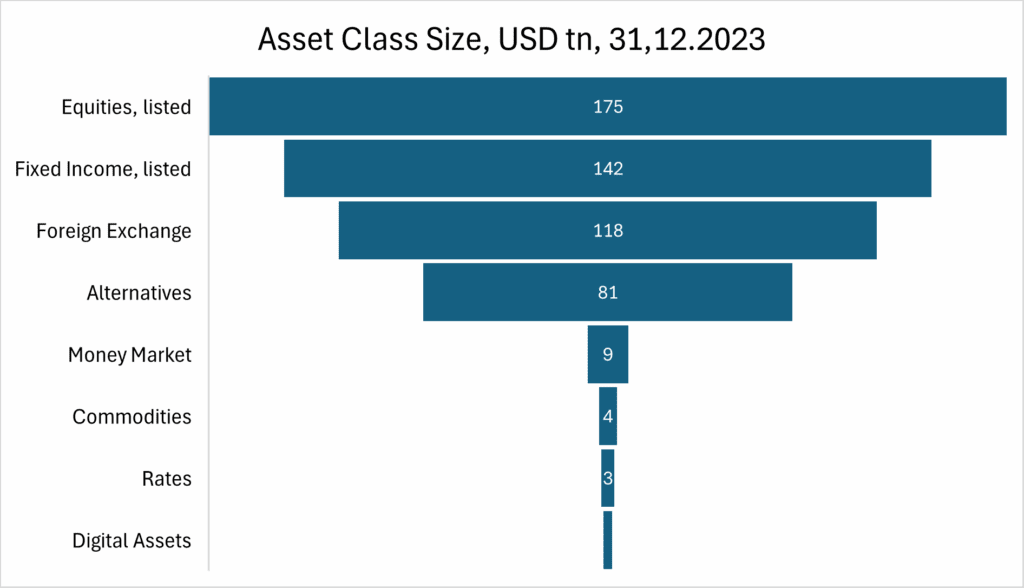
As at 31.12.2023, listed equities were the largest asset class in global capital markets, valued at USD 175tn. Some asset classes are private or traded over the counter (OTC), making valuation and liquidity more difficult.
What size are global Capital Markets?
The largest asset classes by notional outstanding are:
Equities Asset Class
| Description | Shares in a publicly listed company. |
| Typology | Ordinary, preference, class, non-voting. |
| Liquidity | High, but subject to how much of the company is floated, daily volumes, capital markets depth, etc. |
| Returns | Appreciation of value and dividend payments (in cash or shares). |
| Risk | Company performance and market risks. |
Fixed Income Asset Class
| Description | Corporate, FI or Government bonds that are publicly listed. |
| Typology | Fixed, floating, zero-coupon, convertible, callable, putable. |
| Liquidity | High, but subject to the size of issue, daily volumes, capital markets depth, etc. |
| Returns | Appreciation of value, and fixed payment of capital and interest. Equity share if convertible bond. |
| Risk | Counterparty credit and market risk. Typically rated, but care is required on creditor ranking. |
Money Market Asset Class
| Description | Fixed income instruments with a very short-term maturities. |
| Typology | MM account, commercial paper (corporate), treasury bills (government). |
| Liquidity | High if traded, but subject to the size of issue, daily volumes, capital markets depth, etc. |
| Returns | Fixed payment of capital and interest. |
| Risk | Counterparty credit. |
Foreign Exchange Asset Class
| Description | Trading of foreign currencies, 99% traded over the counter (OTC). |
| Typology | Spot, forward, option, futures. |
| Liquidity | Depends on currency pairs and capital markets depth. |
| Returns | Appreciation of value. |
| Risk | Counterparty credit, settlement, and market risk. Higher risks may be collateralised. |
Commodities Asset Class
| Description | Trading of commodities on a listed exchange or over the counter. |
| Typology | Energy, metals, minerals, agricultural, livestock. |
| Liquidity | Depends on the commodity and capital markets depth. |
| Returns | Appreciation of value. |
| Risk | Counterparty credit, settlement, and market risk. Higher risks may be collateralised. |
Alternatives Asset Class
| Description | Non-standard asset types, traded in private markets and often held over a long term. |
| Typology | Private Equity, Private Debt, Real Estate, Collectibles, Infrastructure. |
| Liquidity | Low or very low. |
| Returns | Private Debt is a fixed payment of capital and interest. Real Estate provides an income stream (yield). Others are appreciation of value, which in some cases can be high. |
| Risk | Complex and dependent on each situation, but typically liquidity, counterparty credit, and market risk. In some cases Alternatives have little transparency or regulation. |
Rates Asset Class
| Description | Bonds of a government that are publicly listed or traded over the counter (OTC). |
| Typology | Sovereign, inflation-linked, IR swap, IR option, repo. |
| Liquidity | High, depends on the size of the issue, daily volumes, capital markets depth, etc. |
| Returns | Appreciation of value if bond, fixed payment of capital and interest. |
| Risk | Counterparty credit and market risk. Typically rated, but care is required on creditor ranking. |
Digital Assets
| Description | Digital assets that are publicly listed. |
| Typology | Cryptocurrency, stablecoins, CBDC, NFT. |
| Liquidity | Variable, depends on size of the issue, daily volumes, capital markets depth, etc. |
| Returns | Appreciation of value. |
| Risk | Market, counterparty credit and fraud risk. In some cases highly volatile. |
Cash and Equivalents
| Description | Cash held in a bank, e-money, or investment accounts. |
| Typology | Cash, deposit, certificate of deposit. |
| Liquidity | Very high, although some deposits are subject to a minimum term. |
| Returns | Low, depends on prevailing interest rates. |
| Risk | Counterparty credit risk, may be subject to a guarantee or insurance. |