
What are Interchange Fees and why do they Matter?
Interchange fees are the transaction costs applied to a merchant when a customer makes a card payment. Costs can be significant and opaque.
The sums involved are significant, US merchants paid USD 135bn in interchange fees in 2023, and whilst this funds investment in the card network, it attracts criticism from regulators and competition from FinTechs keen to target profit pools.
Parties in a card payment process
It is important to understand the card payment process, as interchange fees are collected by the payment acquirer and apportioned between the card issuer, card scheme and payment acquirer:
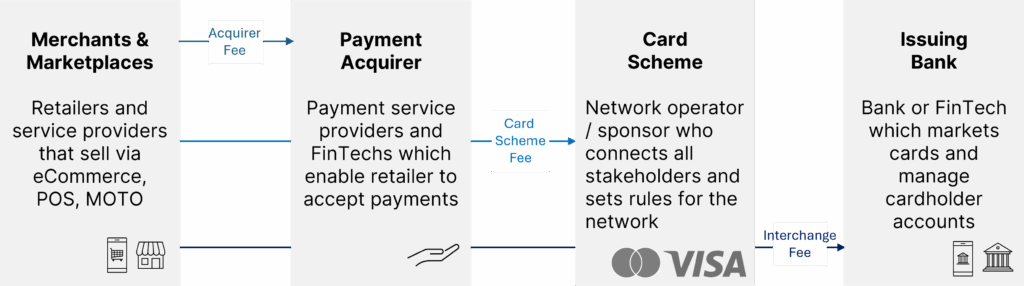
How is a card payment charged?
Contrary to popular belief, the proceeds are not retained by the merchant or bank, but split across the payment ecosystem. Here is how a card payment may be apportioned:

Why the Payments Industry is obsessed with Interchange
The value of interchange is massive and growing, even as alterantive payment methods emerge:
| Credit Cards | Global market was estimated at USD 558bn in 2023, and is expected to grow to USD 1.15tn by 2033. |
| Debit Cards | Global market was valued at USD 95bn in 2023 and is projected to reach $151bn by 2032. |
| Interchange Fees | The Banker estimates that US merchants alone pay USD 135bn in interchange fees in 2023. |
How is interchange calculated?
Interchange fees are set by the card scheme, like Visa and Mastercard. The total interchange fee comprises many elements:
| Card Scheme | Each card scheme has a slightly different rate. |
| Card Type | Credit card payments have higher interchange fees than debit or prepaid because settlement is delayed and involves credit risk. |
| Payment Channel | Payments occur across differerent channels such as eCommerce, POS and MOTO. |
| Industry | Merchants receive a Merchant Category Code (MCC). Industries with a high risk of chargebacks like travel, gambling, and charity pay more. |
| Customer Segment | Corporate cards are exempt from price caps and charged higher interchange fees than consumer. |
| Location | Cross-border and/or currency fees apply if the card payment is made in a country different to where it was issued. |
Why is interchange controversial?
| Merchants | Merchants see the cost of interchange but may not understand how it is calculated. Small merchants pay more than large merchants as they lack economies of scale. |
| Cardholders | Buyers may not know the interchange element or when it has been passed on to them by the merchant. |
| Regulators | Regulators are unhappy about the lack of transparency. Moreover, some cards offer rewards for higher spending, which entices cardholders to take on high-cost credit, with the reward being financed by interchange e.g. the consumer pays twice. Regulators cite card schemes and issuing banks for abuse of power as they hold large market shares. |
Regulation of interchange fees
The card payment market is regulated for data security and pricing:
| EU | Interchange fees are capped at 0.2% for consumer debit/prepaid cards, and 0.3% for consumer credit cards by PSD2. |
| US | Interchange fees of 2% are typical. The Credit Card Competition Act (2022) proposed to break the Visa-Mastercard duopoly and save merchants and consumers USD 15 bn per annum is subject to intense lobbying by the industry. |
In defence, a card scheme is a complex global network which is multi-party and real-time in nature. It takes significant capital to build and technology, compliance and service costs to maintain. The surge in fraud requires card schemes to invest heavily in defences.
How does FinTech affect the Cards industry?
FinTech is driving rapid change across the global payments industry:
Account-to-Account Payments
A2A payments involve the direct transfer of funds from one bank account to another, bypassing the card scheme entirely.
Open Banking
Open Banking provides APIs that allow merchants to easily connect to multple payment rails, and enable 3rd party payment initiation.
PayFac Model
Companies like Adyen play multiple roles. PayFacs utilise modern technology to improve engagement, embed payments and credit into eCommerce, and offer API ecosystems that enable automation. Technology lowers entry barriers to payment processing but not always cost.
Banking-as-a-Service
BaaS allows non-banks to offer financial services. In recent years this has seen the emergence of payment service providers specialising in niches such as card payment.
Alternative Payment Methods
APMs like digital wallets (Google/Apple), PayPal, buy now, pay later” (BNPL) services like Klarna, and crypto payment rails become accessible to merchants.
Interchange Summary
The payment landscape has altered significantly in the past decade as regulation, technology and customer demands impact. Card payments remain favoured for convenience and are forecast to grow, even as many alternatives emerge. Card schemes remain powerful and increasingly acquire to consolidate the payments industry.
How Sure FinTech Helps?
Sure FinTech provides a range of services to help merchants and PSPs:
|
Merchants |
PSPs |
| Sure can help you secure processing and analyse your history to understand if rates are appropriate. | Sure can help you connect with merchants, secure regulatory licenses and source new technologies. |


