Small EMI License vs EMI: Differences, Limits & Rules (2026)

A Small Electronic Money Institution (Small EMI or SEMI) license authorises a firm to issue e-money, hold client funds, and facilitate payment services.
Licensing exists to ensure that providers operate with sound controls, sustainable financials, and effective safeguards for client funds and financial crime.
Small EMI License offers lower barriers to entry than the full EMI License, and securing the license can be faster. Important differences in scope, limits and obligations apply, here is what you need to know about the Small Electronic Money Institution in 2026.
What Services Can a Small EMI Provide?
Under Electronic Money Regulations, an e-money service is defined as:
- Issuance of Electronic Money: issuing digital representations of fiat currency that can be used for payments.
- Redemption of Electronic Money: allowing customers to redeem e-money back into fiat currency at par value.
- Storage of Electronic Money: holding funds as e-money in digital wallets or similar accounts for future transactions.
Small EMI Use Cases
A Small EMI license supports a wide range of financial products and business models, including:
- IBAN Issuance: client named accounts in multiple currencies.
- Neobanking: bundled offer of accounts, payments, FX and cards, often augmented with software for easy management.
- Banking-as-a-Service: allowing 3rd parties to offer account and payment services on your infrastructure in return for a revenue share.
- Prepaid Cards: cards that are loaded with a specific amount of money and can be used for purchases later.
- Online Payment Platforms: websites and apps that orchestrate online transactions and may hold a balance for users.
- Digital Wallets: platforms like PayPal and Revolut that store eMoney to facilitate online payments or money transfers.
- Bank-Linked Digital Wallets: wallets like Google Pay and Apple Pay, where eMoney is linked to bank accounts.
- Mobile Money Services: allow users to store, send, and receive money using their mobile phones, like M-Pesa and GCash.
- Stored-Value Cards: cards like Oyster which are preloaded with money and used for transportation or other services.
- Voucher Schemes: users purchase vouchers online or at kiosks then user them to redeem for online purchases, like PaySafeCard (ex Skrill).
…plus most use cases permitted as a Payment Institution.
What Can’t a Small EMI Do?
E-money has a distinct legal and regulatory definition, and a Small Electronic Money Institution is not permitted to:
- Hold client funds in cash or cryptocurrency form.
- Pay interest on client funds.
- Offer deposit guarantees.
Additional restrictions on a Small Electronic Money Institution are:
- Small EMIs cannot passport across borders.
- Small EMIs cannot offer account information or payment initiation services (Open Banking).
Benefits of a Small EMI License
Compared to a full EMI license, a Small EMI can benefit from:
- Faster regulatory approvals.
- Lower initial and ongoing capital requirements.
- Easier ongoing compliance.
Restrictions on a Small EMI
In return for lighter regulation, a Small EMI license places certain restrictions that the full EMI license does not:
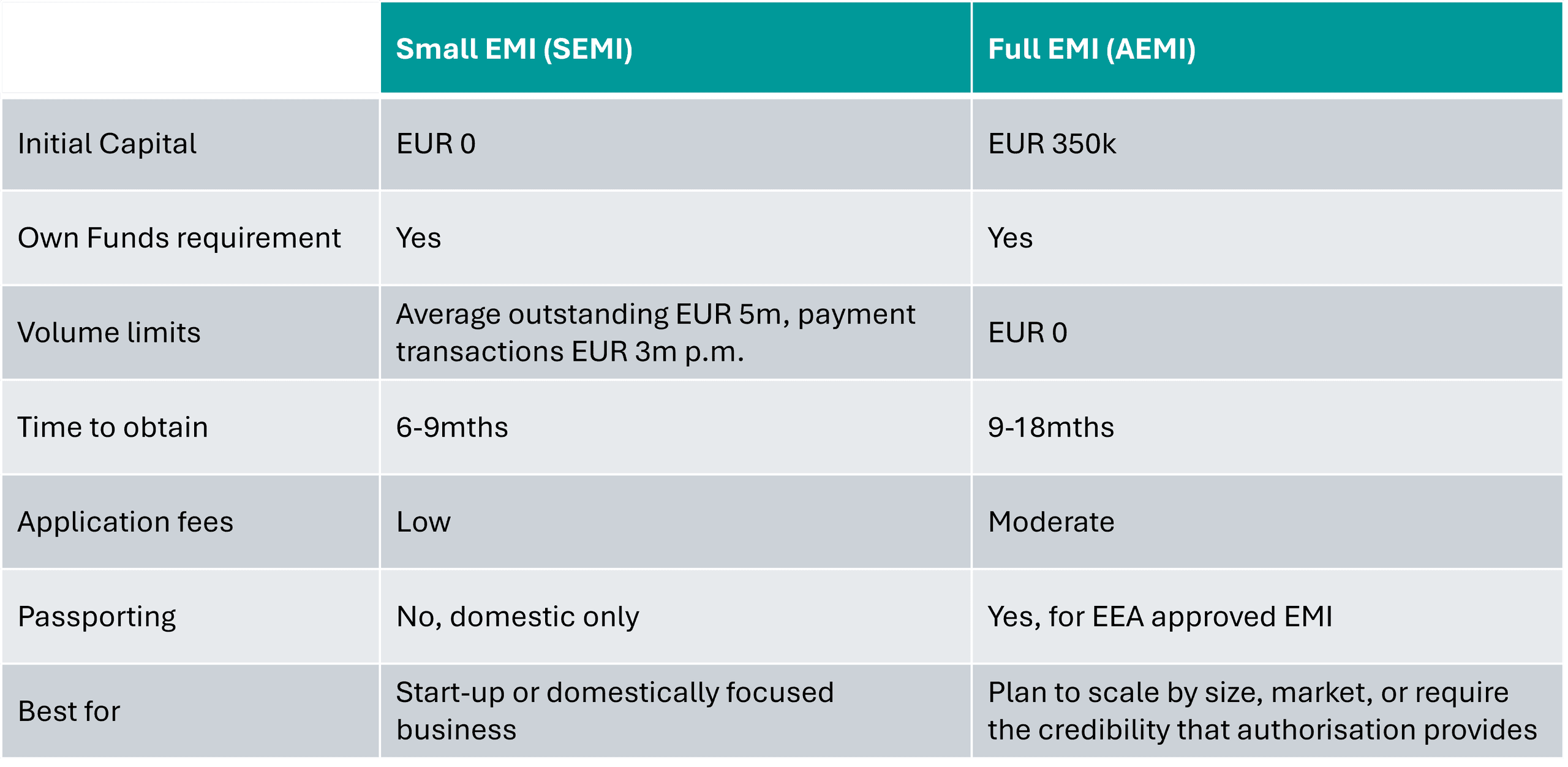
- e-money Outstanding: monthly average outstanding e-money cannot exceed EUR 5m.
- Transaction Volumes: monthly average of payment transactions cannot exceed EUR 3m.
Small EMI License Process
The Small EMI license process broadly mirrors the EMI license, with several requirements reduced for Small EMIs.
Small EMI License v Full EMI License Differences
Small EMI FAQs
What are the Small EMI capital requirements?
There are no initial capital requirements for Small EMIs, although conditions apply.
What are the Small EMI own-funds requirements?
Own-Funds requirements apply, for example in the UK if the SEMI holds over GBP 500k in client funds, it must hold 2% own-funds on the balance sheet. Check your jurisdiction.
Can a Small EMI hold client money?
Yes, a Small EMI can hold client funds in e-money form, but is prohibited from paying interest on those funds.
Are Small EMIs required to safeguard client money?
Yes, Small EMI safeguarding requirements are similar to those of fully authorised EMIs.
How long does a Small EMI license take?
It depends on the business model and jurisdiction, 6-9mths is not unusual.
Small Electronic Money Institution License Summary
A Small Electronic Money Institution license enables the provision of financial services, including holding client funds and integrating payments, with a lighter regulatory footprint than a full EMI.
If you are a start-up or domestically focused business, a Small EMI may be optimal. If you plan to scale in size or market or require the credibility that authorisation provides, a full EMI license is more appropriate.
In all cases, conditions apply, regulatory expectations are increasing, and processes are demanding. Having a good advisor and gameplan sends positive signals to regulators, BaaS and technology providers.
Sure FinTech supports clients end‑to‑end — regulatory strategy, license applications, technology and BaaS sourcing, and ongoing compliance. Contact us today for an exploratory call about the Small EMI license.
