
Skip to content
  • Services
    • Fintech Strategy
    • Fintech Regulation
    • Fintech Sourcing
    • Strategy Expert advice on markets, products and funding
    • Regulation Secure licenses and meet compliance obligations
    • Solutions Source reliable financial and technology solutions
  • Sectors
    • Payments
    • eCommerce
    • FinTechs
    • Crypto Assets
    • Lenders
    • Banks
    • Private Equity
    • Governments
    • Payments Launch fast, grow volumes and reduce financial crime
    • eCommerce Secure processing, increase conversions and reduce cost
    • FinTechs Integrated commercial, technology, and funding plans
    • Crypto Assets Capture financial, technology and regulatory opportunities
    • Lenders Grow lending, reduce NPLs and automate processes
    • Banks Offer personalised CX, improve efficiency and agility
    • Private Equity Access FinTech deal flow and maximise returns
    • Governments Craft policy to generate investment and jobs
  • Resources
    • Case Studies
    • Financial Services Insights
    • FinTech Marketplace
    • Case Studies 20-year track record with world-class clients
    • Blog Stay ahead of the market with data and insights
    • FinTech Marketplace Understand financial and technology solutions
  • About
    • Management
    • Why Us
    • Contact
    • Management Meet our financial services experts
    • Why Us Discover our attributes and values
    • Contact Request a call today

Get started

Give us a call or fill in the form below and we will contact you. We endeavor to answer all inquiries within 24 hours on business days.


0 / 360
Financial Technology

What is Open Banking? Beyond Payments

March 12, 2026 neilmathieson Comments Off on What is Open Banking? Beyond Payments
Open banking while shopping online

Open Banking allows third-party providers (TPPs) to source account data and initiate payments from a customer’s account at another financial institution.

Open Banking is used by financial and non-financial businesses to innovate new services, automate processes, and make decisions that were previously excluded, giving customers better choices and experiences.

Consumers and businesses must consent to their data being shared with the TPP, who in turn must be regulated.


Types of Open Banking

Payment Initiation

Payment Initiation Service Providers (PISPs) are permitted to initiate payments directly from a customer’s account.

Account Aggregation

Account Initiation Service Providers (AISPs) are permitted to aggregate information from multiple accounts to gain a comprehensive view in one place.


Open Banking Use Cases
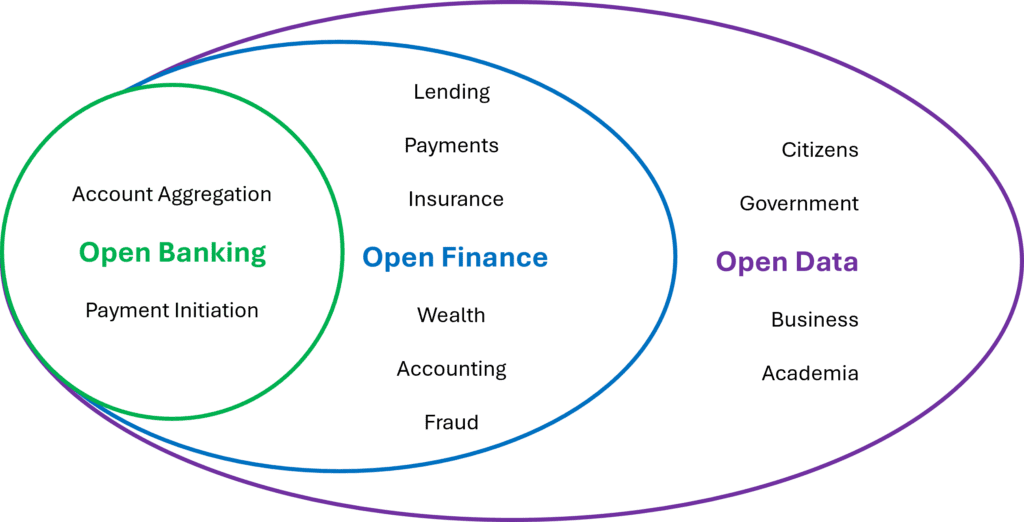
Open Banking postioning

Payments

Whether paying a bill or buying online, payments are embedded in the commercial process, making reducing friction for consumers and helping businesses increase conversions.

Lending

Lenders can verify income and expenses in 3rd party accounts. This allows them to make credit assessments in real-time to support online lending, embedded credit such as buy now, pay later (BNPL) and complex loans.

Insurance

Insurance companies can enrich their dataset and identify patterns, making it easier to assess coverage, provide customised offers, and price risk.

Wealth

Open Banking provides insights for budgeting and enables sweeping of excess balances to savings and investment products, either as a single or recurring payment.

Accounting

Finance platforms utilise Open Banking to match invoices issued/paid to bank account movements, improving AR/AP processes and working capital.

Fraud

The ability to analyse data and request authentication allows businesses to identify fraud faster and reduce the risk of loss.


How does Open Banking work?
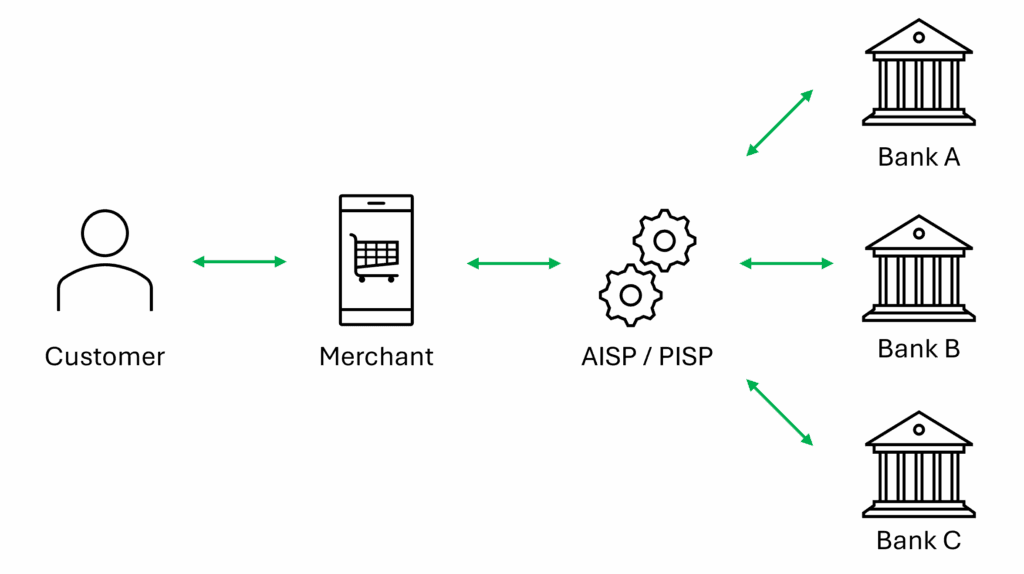
Open Banking process

Open Banking relies on Application Programming Interfaces (APIs) to pass standardised data between the AISP/PISP and financial institution(s) in a secure manner.

APIs enable technologies to integrate, in real-time with business rules and protocols applied, to make the transaction is seamless.

Open Banking requires a customer’s consent, which must be verified by entering their bank login credentials when prompted.

Once the bank verifies the user, it generates an encrypted token that identifies the customer but does not expose their credentials.

To enable the transaction, the customer must authenticate the transaction, with a second token issued to complete the transaction.

Use of strong customer authentication (SCA) and tokenisation protects against financial crime.


Benefits of Open Banking

Open Banking fosters competition in financial services by allowing TPPs to access data and initiate payments.

Digital business models, like ecommerce and fintechs, use this to build enhanced capabilities, including decisioning, processes to products. Revenues are increased and risks reduced.

Open Banking users generate deep insights on their finances and receive personalised offers with seamless user experiences. Open Banking can deliver lower payments costs, yield maximisation, access to credit, and time savings.


Problems with Open Banking

Not all Banks support Open Banking, typically due to concerns about data privacy and granting third-party access.

Not all customers are happy about data sharing. Although consent must be given and authenticated, concerns about inappropriate usage exist.

Participants require good technology, including a good core banking or payments system which can operate securely in real-time, and CRM capability to manage consents


Open Banking Summary

After slow adoption, Open Banking in Europe is growing as measured by active users, payments volumes and API calls.

Further growth is expected due to positive regulatory factors, IT interoperability, and additional usage in digital business models.

Fragmented technology and financial systems can limit application, but customers expect personalised offers with seamless experiences, creating a business case on which to build.


  • Banks
  • eCommerce
  • Fintechs
  • Lenders
  • Payments
neilmathieson

Post navigation

Previous
Next

Search

Categories

  • Capital Markets (2)
  • Financial Services (2)
  • Financial Services Regulation (2)
  • Financial Technology (11)

Recent posts

  • Open banking while shopping online
    Open Banking in Europe
  • Banking as a service for ecommerce
    What is Banking as a Service?
  • Open banking while shopping online
    What is Open Banking? Beyond Payments

Tags

Banks Crypto Assets eCommerce Fintechs Governments Lenders Payments Private Equity

Continue reading

Open banking while shopping online
Financial Technology

Open Banking in Europe

March 18, 2026 neilmathieson Comments Off on Open Banking in Europe

Open Banking emerged as a concept in 2010s, as regulators sought to stimulate competition and innovation in financial services. On launch in 2018, adoption was slow as fragmented technology, concerns about data sharing, and limited use cases created headwinds. Over time, the popularity of digital business models such as fintech and ecommerce grew among consumers […]

Banking as a service for ecommerce
Financial Services, Financial Technology

What is Banking as a Service?

March 16, 2026 neilmathieson Comments Off on What is Banking as a Service?

Banking as a Service (BaaS) occurs when an authorised financial institution allows a non-bank business to offer financial services on a white-label basis. This allows the non-bank to creatie new revenue streams, better customer experiences and deeper relationships. BaaS lowers the barrier to entry to financial services and is profitable at scale. However, it remains […]

European Financial Centres
Financial Services

European Financial Centres: Driving Economic Development

January 6, 2026 neilmathieson Comments Off on European Financial Centres: Driving Economic Development

Financial Services are significant in Europe, accounting for over 9% of economic output. London and Frankfurt

Want to receive news and updates?


    Profit at the intersect of finance and technology.

    Services
    • Strategy
    • Regulation
    • Solutions
    Sectors
    • Payments
    • Ecommerce
    • FinTechs
    • Crypto Assets
    • Lenders
    • Banks
    • Private Equity
    • Governments
    Resources
    • Case Studies
    • Blog
    • FinTech Marketplace
    • FinServ Marketplace
    About
    • Management
    • Why Us
    • Contact

    © 2005-2026. All Rights Reserved.

    • Terms & Conditions
    • Privacy Policy