
Skip to content
  • Services
    • Fintech Strategy
    • Fintech Regulation
    • Fintech Sourcing
    • Strategy Expert advice on markets, products and funding
    • Regulation Secure licenses and meet compliance obligations
    • Solutions Source reliable financial and technology solutions
  • Sectors
    • Payments
    • eCommerce
    • FinTechs
    • Crypto Assets
    • Lenders
    • Banks
    • Private Equity
    • Governments
    • Payments Launch fast, grow volumes and reduce financial crime
    • eCommerce Secure processing, increase conversions and reduce cost
    • FinTechs Integrated commercial, technology, and funding plans
    • Crypto Assets Capture financial, technology and regulatory opportunities
    • Lenders Grow lending, reduce NPLs and automate processes
    • Banks Offer personalised CX, improve efficiency and agility
    • Private Equity Access FinTech deal flow and maximise returns
    • Governments Craft policy to generate investment and jobs
  • Resources
    • Case Studies
    • Financial Services Insights
    • FinTech Marketplace
    • Case Studies 20-year track record with world-class clients
    • Blog Stay ahead of the market with data and insights
    • FinTech Marketplace Understand financial and technology solutions
  • About
    • Management
    • Why Us
    • Contact
    • Management Meet our financial services experts
    • Why Us Discover our attributes and values
    • Contact Request a call today

Get started

Give us a call or fill in the form below and we will contact you. We endeavor to answer all inquiries within 24 hours on business days.

Edit Content

0 / 180
Financial Technology

What is payment tokenization? How PSPs improve a payment journey

December 3, 2025 neilmathieson Comments Off on What is payment tokenization? How PSPs improve a payment journey
Image depicting what is payment tokenization on a payment journey
  • Tokenization converts sensitive card data into random code during the payment journey.
  • Tokens can be used in online checkouts, recurring billing, and mobile wallets.
  • Tokenization can protect cardholders and PSPs from financial crime.
  • Tokenization increases sales by creating easy checkouts for returning customers and recurring payments.
  • Rapid advances in financial crime and technology make it essential to review regularly.

Payment tokenization explained

Tokenization is a technique that replaces sensitive card data, such as name and primary account number (PAN), with a unique random code.

Tokens are ideal for storing sensitive data against financial crime such as unauthorised access (internal fraud) and data breaches (external hack).

Tokens increase sales by reducing the need to re-key data, creating a speedy checkout for returning customers, enabling recurring payments, and storing details in digital wallets.

What tokens do PSPs use?

Single-use tokens are only valid for one transaction.

Multi-use tokens can be used for recurring payments.

Network tokens are issued by card schemes like Visa and Mastercard for specific devices or merchants.

How does payment tokenization work?

Tokenization occurs when a cardholder enters their payment on a website or mobile app. The payment gateways of the PSPs generate a token which is passed between stakeholders in the payment journey:
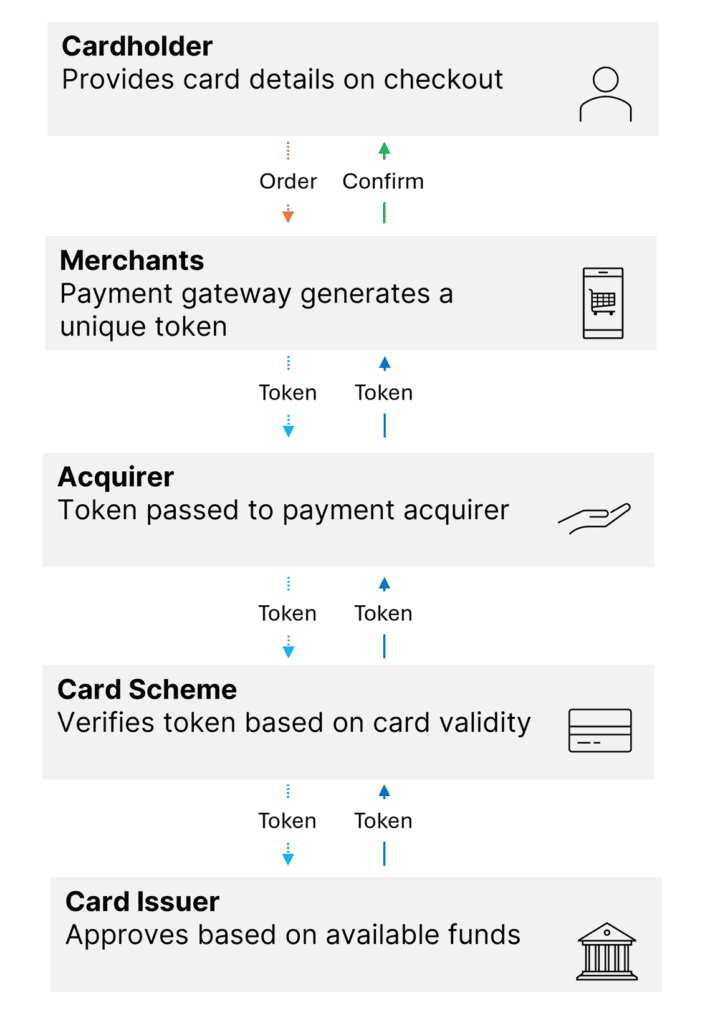
Diagram showing stakeholders in the payment journey and what is payment tokenization

Payment tokenization for recurring payments

Tokens are reusable within certain parameters, making them ideal for businesses where customers purchase repeatedly, have loyalty schemes, subscriptions, or digital wallets.

Rather than ask the client to re-enter details, the business utilises the stored token, adding a verification step such as CVC or 2FA as appropriate.

Benefits of payment tokenization

Enhanced Data Security

Holding data in tokenized form makes it illegible to fraudsters and hackers who use card data for illicit purposes. As financial crime booms, tokenization is critical for eCommerce and PSPs.

Increased Sales

Tokenization improves the checkout experience as it removes the need to re-key card details, reducing friction and increasing conversions. Tokenization also protects customer card data, a key trust factor in recurring purchases.

Omnichannel Capability

Tokenization can be applied to any card regardless of whether the transaction occurs in an eCommerce or digital wallet environment.  Standardization across channels helps reduce complexity and costs.

Demonstrate PCI Compliance

Tokenization is a key criteria of the Payment Card Industry Data Security Standard (PCI DSS) that merchants, payment gateways, and a PSP are required to meet to process card payments.

Automated Updates

In some cases, tokens can be updated automatically by the provider, allowing recurring payments to occur without interruption.

Is tokenization the same as encryption?

No. Tokenization replaces data with a random token whereas encryption scrambles data using cryptography. Tokenization is not mathematical, encryption is and may be deciphered. In reality, a payment journey will use both, tokenization for data storage, encryption for data transmission.

Summary of payment tokenization

To succeed in ecommerce and fintech requires the seamless integration of excellent customer experience with effective financial services and technology. Payment tokenization is the enabler of that.

As financial crime booms, it is also a critical element of maintaining high security as data is passed and stored along the payment journey.

With AI enabling more elaborate financial crime, merchants and PSPs must adopt the highest levels of protection and review arrangements regularly.

  • Banks
  • eCommerce
  • Fintechs
  • Payments
neilmathieson

Post navigation

Previous
Next

Search

Categories

  • Capital Markets (2)
  • Financial Services (1)
  • Financial Services Regulation (2)
  • Financial Technology (8)

Recent posts

  • European Financial Centres
    European Financial Centres: Driving Economic Development
  • An elegant Sovereign Wealth Funds building
    Sovereign Wealth Funds: Moving Capital Markets
  • EU DORA
    EU DORA: What Financial Firms and FinTechs Must Know

Tags

Banks Crypto Assets eCommerce Fintechs Governments Lenders Payments Private Equity

Continue reading

European Financial Centres
Financial Services

European Financial Centres: Driving Economic Development

January 6, 2026 neilmathieson Comments Off on European Financial Centres: Driving Economic Development

Financial Services are significant in Europe, accounting for over 9% of economic output. London and Frankfurt

EU DORA
Financial Services Regulation

EU DORA: What Financial Firms and FinTechs Must Know

December 16, 2025 neilmathieson Comments Off on EU DORA: What Financial Firms and FinTechs Must Know

The EU Digital Operational Resilience Act became mandatory on 17.01.2025 and seeks to improve operational risk and business continuity in EU financial services. With 70+ pages and hundreds of requirements, DORA sets a new standard for financial services ICT

EU DORA
Financial Services Regulation

EU DORA: Regulators announce Critical ICT Third-Party Providers

December 14, 2025 neilmathieson Comments Off on EU DORA: Regulators announce Critical ICT Third-Party Providers

On 18.11.2025 the European Supervisory Authorities announced 19 information and communications companies as Critical Third-Party Providers (CTPPs) under DORA.

Want to receive news and updates?


    Profit at the intersect of finance and technology.

    Services
    • Strategy
    • Regulation
    • Solutions
    Sectors
    • Payments
    • Ecommerce
    • FinTechs
    • Crypto Assets
    • Lenders
    • Banks
    • Private Equity
    • Governments
    Resources
    • Case Studies
    • Blog
    • FinTech Marketplace
    • FinServ Marketplace
    About
    • Management
    • Why Us
    • Vacancies
    • Contact

    © 2005-2026. All Rights Reserved.

    • Terms & Conditions
    • Privacy Policy