
What are interchange fees and why do they matter?
- Interchange fees are applied when a customer makes a credit or debit card payment.
- Interchange is calculated based on multiple factors and represents a significant cost.
- US merchants paid USD 135bn in interchange fees in 2023.
- Interchange is regulated and its revenues fund investment by card networks, but is subject to criticism.
- FinTech provides alternative payment options, helping merchants improve customer experience and cost efficiency.
What are interchange fees?
Interchange fees are the costs applied to a merchant when a customer makes a credit or debit card payment. The fee is collected by the payment acquirer and then apportioned to the card issuer, card network and acquirer.
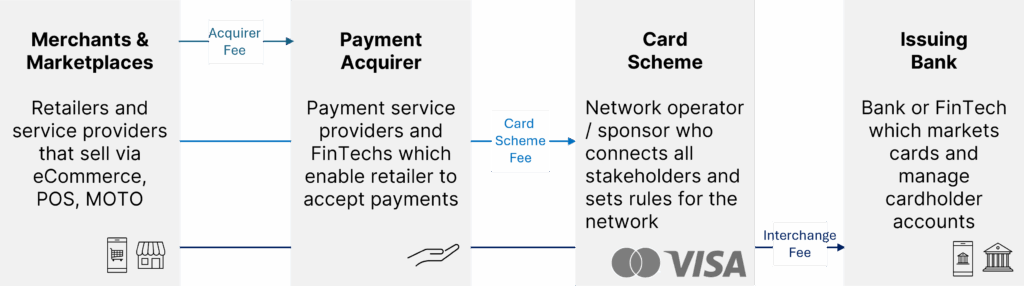
Example of interchange fees?
For an EUR 100 card payment the unit economics may be:

Why do interchange fees matter?
The value of card payments is massive. In 2023, the global credit card market was estimated at USD 558bn, moreover, it is expected to grow to USD 1.15tn by 2033 as cards offer a convenient alternative to cash and, increasingly, affordability.
The global debit card payments market was valued at USD 95bn in 2023 and is projected to reach $151bn by 2032.
Research quoted by The Banker estimates that US merchants alone pay USD 135bn in interchange fees.
Who sets interchange fees?
Interchange fees are set by the card schemes like Visa and Mastercard. They use the proceeds to run their payment networks which have heavy technology, compliance and service requirements.
How is interchange calculated?
Visa and Mastercard publish their rates, on average these are 0.3 to 0.4% in Europe and 2% in the US. However, the total interchange fee comprises many elements:
Card Scheme: Each card scheme has a different interchange rate, the cost of paying with Visa is different to Mastercard.
Card Type: Credit cards have higher interchange fees than debit and prepaid cards because settlement is after 30 days and involves credit risk.
Payment Channel: Each card scheme has a different interchange rate, the cost of paying with Visa is different to Mastercard.
Industry: Merchants receive a merchant category code (MCC) based on their industry. Some industries like travel, gambling, and charity have high chargebacks.
Customer: Corporate cards are exempt from price caps and charged higher interchange fees than consumer cards.
Location: Cross-border and/or currency fees will apply if the transaction is made in a country different to where the card is issued.
Why is interchange controversial?
Merchants
Merchants know the cost of Interchange but may not necessarily understand how this rate was calculated. Small merchants typically pay more than large merchants as they lack economies of scale.
Cardholders
Buyers may not know the interchange element even if it has been passed on to them by the merchant.
Regulators
Regulators have long been unhappy about the lack of transparency that merchants and consumers face.
Some cards offer rewards for higher spending or cashback. These rewards encourage consumers to take high-cost credit with the rewards being financed by higher interchange e.g. the consumer pays twice.
Regulators often cite the card schemes and card issuing banks for abuse of power as they hold large market shares.
Regulation of interchange fees
In the EU, interchange fees are capped at 0.2% for consumer debit and prepaid cards, and 0.3% for consumer credit cards since 2015 following the PSD2 regulation. Corporate cards are excluded. The UK and EEA mirror the EU.
In the US, the Credit Card Competition Act proposed in 2022 to break the Visa-Mastercard duopoly and save merchants and consumers USD 15 bn per annum is now subject to intense lobbying against it by the financial services industry.
How do card schemes justify interchange fees?
Card schemes are extremely complex global networks, multi-party and real-time in nature. It takes significant capital to build them and maintain them.
Moreover, the surge in financial crime has required card schemes to invest heavily in technological and non-technological defence to thwart criminals.
Card schemes also publish their Interchange fees, however the final cost to the merchant is always subject to additional variables.
Can merchants negotiate interchange fees?
Potentially. A payments advisor like Sure can analyse a merchant’s processing history and merchant service agreement to understand if rates are appropriate for your risk and wider market.
The cost of payment processing must also be considered alongside other factors including the payment mix, acceptance rate, settlement terms, quality of service, customer experience, etc.
How does FinTech affect interchange?
Account to Account Payments
Account-to-Account (A2A) payments involve the direct transfer of funds from one bank account to another, bypassing the intermediaries like credit cards or payment processors.
Open Banking
Open Banking provides secure, real-time connectivity to banks using API. In addition to account data, open banking providers enable payment initiation (of account-to-account payments).
PayFac Model
In recent years payment facilitators like Stripe have disrupted the payments landscape. PayFacs can play multiple roles in the payment process, including card issue, card acquiring, provision of merchant accounts, checkouts and payment gateways, thus allowing them to capture a greater share of economics. PayFacs utilise modern technologies, this has driven innovation in customer self-service, embedding of payments and credit into eCommerce, and API ecosystems that enable automation.
Banking-as-a-Service
BaaS allows service providers to offer financial services using the infrastructure of other (larger) parties. In recent years this has seen the emergence of many new payment service providers specialising in niches such as card issuance.
Alternative payment methods
Fintech is expanding the payment options available to merchants. Examples include bank transfer (see A2A), digital wallets like Google Pay, Apple Pay, and PayPal, buy now, pay later” (BNPL) services like Klarna, cryptocurrencies and direct debit.
Interchange Summary
The payment landscape has altered significantly in the past decade as regulation, technology and customer demands have impacted. Card payments remain favoured for convenience and are forecast to grow, even as alternatives emerge. Card schemes remain powerful and increasingly consolidate the payments industry, however, merchants have a greater choice of providers, and more tools to analyse costs, than at any time in history.