
Core Banking in Europe 2025: Driving digital financial services

Core banking systems are the foundational infrastructure for modern Banks, Payment Service Providers (PSPs), and FinTechs. As the industry shifts, next-generation core banking systems are replacing legacy monoliths. The benefits are compelling; better time-to-market, client experiences, operating efficiency and business model agility.
Sure tracks of 60 providers of Core Banking in Europe as at Q3 2025, see key trends and players here:
What is a Core Banking System?
Whilst each system varies, core banking has features that differentiate the segment from alternatives like Loan Management, Treasury Management and Payment Hub alternatives:
| Multi-Tenant | Run multiple, complex entities on a single platform. |
| Asset Classes | Process transactions across cash, fixed income, FX and other asset classes. |
| Payment Rails | Connect to SWIFT, SEPA and local rails to provide choice in currency, settlement speed, and cost. |
| General Ledger | Account for transactions and entities, create reports for management and regulators. |
| Configuration | Configure products, prices, workflows, and user management. |
| Governance | Embed policies and rules into processes, full audit trail of user and client activity helps users demonstrate compliance. |
What is Next-Generation Core Banking?
Banking technology has evolved significantly over the 15 years, from monolithic, on-premise solutions to agile cloud platforms characterised by:
| Composable | “Plug and play” microservices, from single-product to full-stack banking suites. |
| Real-Time | Process high volumes of transactions across multiple channels in real-time. |
| API-First | Seamlessly integrate Client Engagement and RegTech systems for end-to-end process automation. |
| AI & Data | Insights pave the way for advanced Artificial Intelligence in risk, fraud and other areas. |
| SaaS Models | Simplified infrastructure and contracts reduce deployment effort, make spend usage-based and reduce vendor lock. |
Next-Generation Core Banking use cases
Financial institutions are adopting next-generation core banking across a wide range of use cases:
| Core Transformation | Migrate from legacy to a modern, future-proof platform that is more efficient. |
| Client Onboarding | Real-time AML/CTF checks to open accounts in seconds. |
| Loan Automation | Automate the loan life cycle across origination, credit scoring, disbursement, limit management, collateral, collection, NPLs, and reporting. |
| Payments Hub | Single API connectivity to cards, wallets, and global payment rails. |
| Markets | Trade in real-time and manage portfolios across asset classes. |
| Start-Ups | Launch quickly and economically with ready solutions. |
Benefits of Next-Generation Core Banking
Upgrading a core banking system has challenges but is a matter of competitiveness and compliance:
| Client Centricity | Enable personalised experiences with frictionless processes, improving loyalty. |
| Time-to-Market | Next-generation core systems shorten the time required to launch by up to 80%1. |
| Lower Costs | Save up to 50%1 over legacy solutions by simplifying the technology stack, automating operations, and reducing maintenance. |
| Regulatory Trust | Regulators requre core systems to be reliable, secure and meet regulatory requirements. |
| Agility | Next-generation core banking it easy to adapt, swap components and API partners to stay effective. |
Core Banking in Europe: Key Players
Sure tracks 40 established core banking providers in Europe, with a further 20 early-stage ventures on our watchlist:
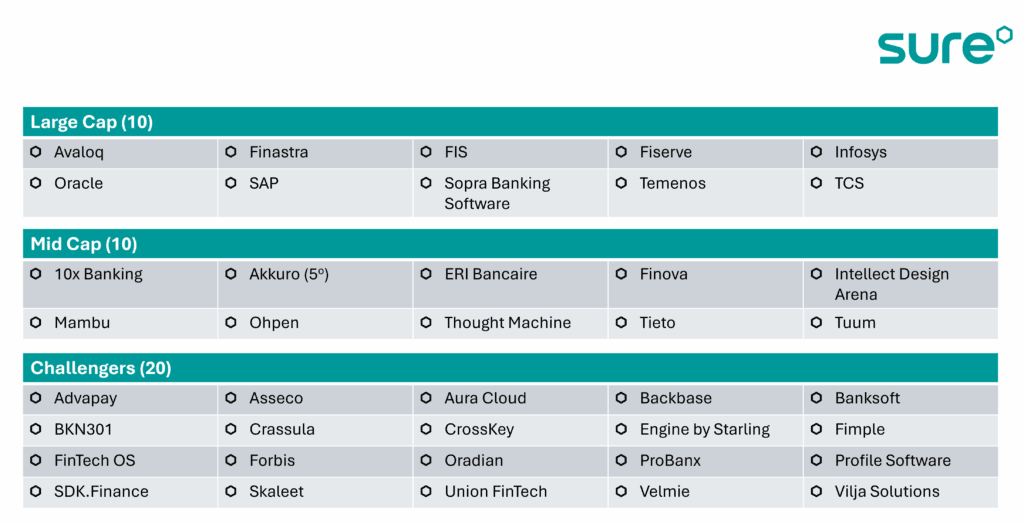
Large Cap: global incumbents provide scale and stability for Tier-1 banks.
Mid Cap: innovative providers that have secured private equity funding and clients based on next-generation technology.
Challengers: 20 providers, often focusing on specific niches or regions.
How Sure FinTech Helps
Sure FinTech provides a range of services to support core banking in Europe:
| Financial Institutions | FinTechs | Private Equity Investors |
| Understand trends, define requirements and connect with core banking providers. | Understand buyer needs and behaviours, meet qualified buyers. | Enhance origination and portfolio performance with industry, company and technical insights. |
Contact Us today for a free consultation.
